A simple guide to building a balanced workout
Knowing how many exercises to include in a workout can be confusing, particularly when you’re starting out. With so much advice available, it’s easy to feel that you need to spend hours in the gym or follow a complicated training plan to make progress.
The truth is, a good workout doesn’t need to be complicated.
Whether your goal is to build strength, improve fitness, develop muscle or simply feel better in everyday life, the key is finding a routine that works for your ability, lifestyle and goals.
In this guide, we’ll look at how many exercises you might need, how sets and repetitions work, and how to approach different muscle groups.
How Many Exercises Should You Do Per Workout?
There is no single number that works for everyone. Your experience, available time, training goals and recovery all play a part.
As a general starting point, around 4–8 exercises can provide a balanced full-body workout. You don’t need to train every muscle individually in every session, as many exercises work several muscle groups together.
For example, a squat works your legs and glutes, while a press involves your chest, shoulders and triceps.
The aim is to cover the main movement patterns rather than simply collect as many exercises as possible.
Understanding Sets and Reps
Two terms you’ll hear regularly in training are *repetitions* and *sets*.
- Reps: The number of times you perform a movement.
- Sets: A group of repetitions followed by a rest period.
For example, 3 sets of 10 squats means completing 10 squats, resting, then repeating twice more.
For general strength and fitness, 2–3 sets of an exercise can be a useful starting point. The number of repetitions will depend on the exercise, resistance and your goal.
Start with a manageable amount of work and focus on performing each movement with good technique.
How Many Exercises Per Muscle Group?
Rather than trying to exhaust one muscle group in a single session, think about spreading your training across the week.
Here are some examples of the main areas you can include in a balanced routine.
Chest
The chest is involved in pushing movements. Exercises include:
- Press-ups
- Dumbbell chest press
- Incline press
- Chest press machine
You can combine chest exercises with shoulder or triceps training, as these muscles also contribute to pushing movements.
Back
Your back supports posture, pulling movements and everyday activities such as lifting and carrying.
Examples include:
- Seated rows
- Lat pulldowns
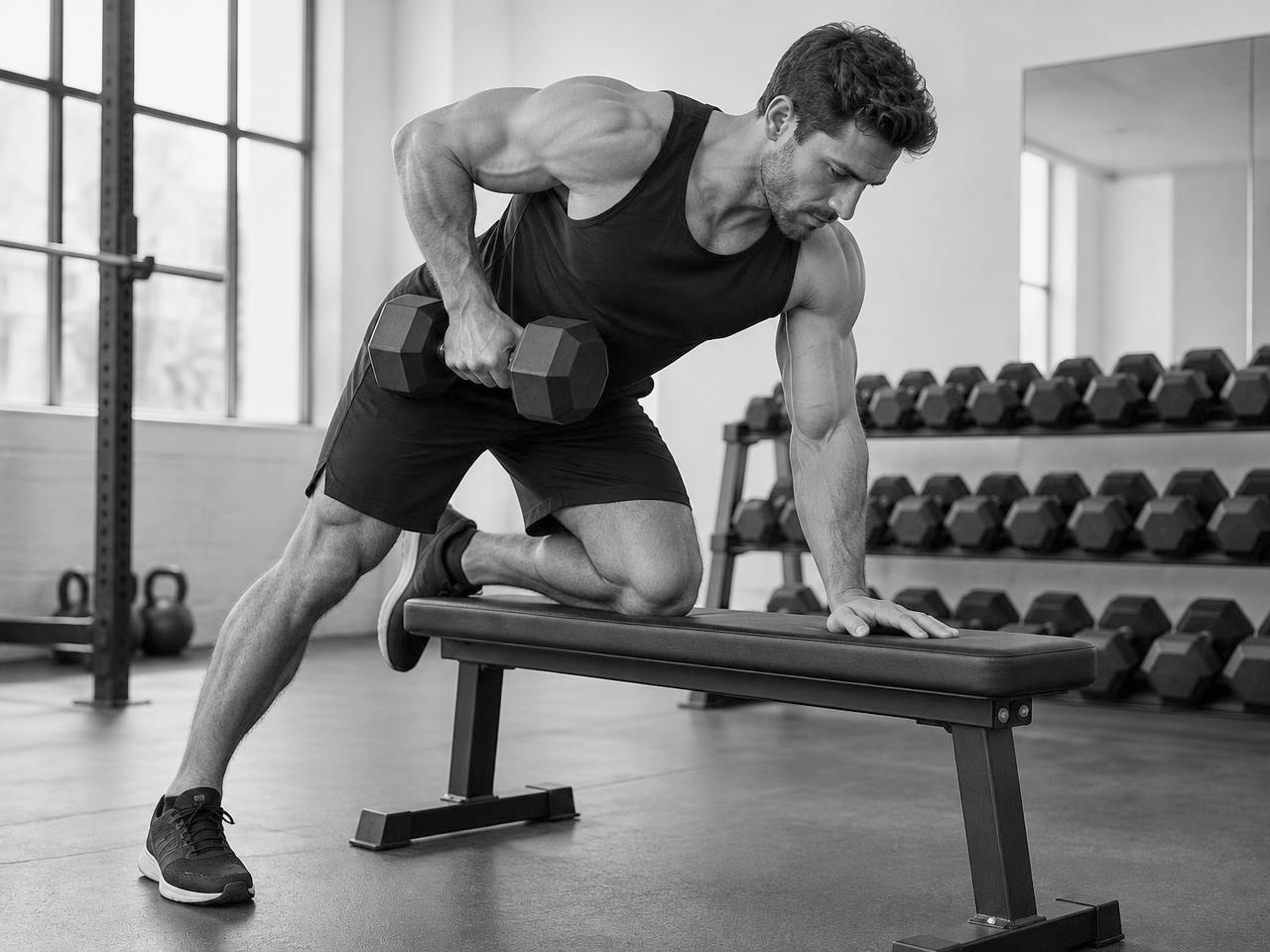
- Dumbbell rows
- Assisted pull-ups
A balanced routine should include both horizontal and vertical pulling movements over time.
Arms and Shoulders
The arms and shoulders contribute to pushing, pulling and stabilising movements.
Examples include:
- Bicep curls
- Tricep extensions
- Shoulder press
- Lateral raises
- Dumbbell rows
You don’t necessarily need a separate exercise for every small muscle. Many compound movements already involve these areas.
Legs and Glutes
Your lower body provides strength, stability and power for walking, running, jumping and everyday movement.
Examples include:
- Squats
- Lunges
- Step-ups
- Glute bridges
- Romanian deadlifts
- Calf raises
Aim to include a mixture of movements that challenge your legs through different ranges of motion.
Core and Abs
Your core includes muscles around your midsection that help support your spine, balance and control.
Examples include:
- Planks
- Dead bugs
- Bird dogs
- Side planks
- Controlled crunches
Core training is about stability and control, not simply performing as many sit-ups as possible.
How Much Training Do You Need at Different Fitness Levels?
Your training plan should develop as your confidence and ability improve. More exercises are not automatically better.
Beginner
If you’re new to regular exercise, start with a simple full-body routine.
Around 4–6 exercises covering the main movement patterns is a practical starting point. Prioritise learning technique, building consistency and allowing your body to adapt.
Two or three sessions per week may be enough to establish a routine.
Intermediate
If you’ve been training consistently and feel comfortable with the main movements, you can begin adding variety or gradually increasing the challenge.
You might use 5–8 exercises in a session, depending on how your training is structured.
Focus on progressive improvement rather than adding exercises for the sake of it.
Advanced
More experienced training can involve greater variation, volume and intensity, but this should still be balanced with recovery.
The number of exercises will depend on whether you are following a full-body, upper/lower or muscle-group split.
Even experienced athletes benefit from keeping their training purposeful.
How Often Should You Train Each Muscle Group?
For many people, training major muscle groups around twice per week is a useful structure.
This allows you to distribute your training rather than trying to complete everything in one session.
Recovery is just as important as the workout itself. Sleep, nutrition, rest days and managing training intensity all contribute to progress.
If you are consistently sore, unusually fatigued or struggling to maintain good technique, consider reducing the workload.
The Takeaway
The best workout is not necessarily the longest or hardest. It is the one you can perform consistently, recover from and build upon.
Start with the basics. Learn the movements. Give yourself time to improve.
Fitness is not about doing everything at once. It’s about making small, repeatable steps that add up over time.